
Articles
Why Does Charcoal Burn Hotter Than Wood? A Buyer's Guide
Admin ·
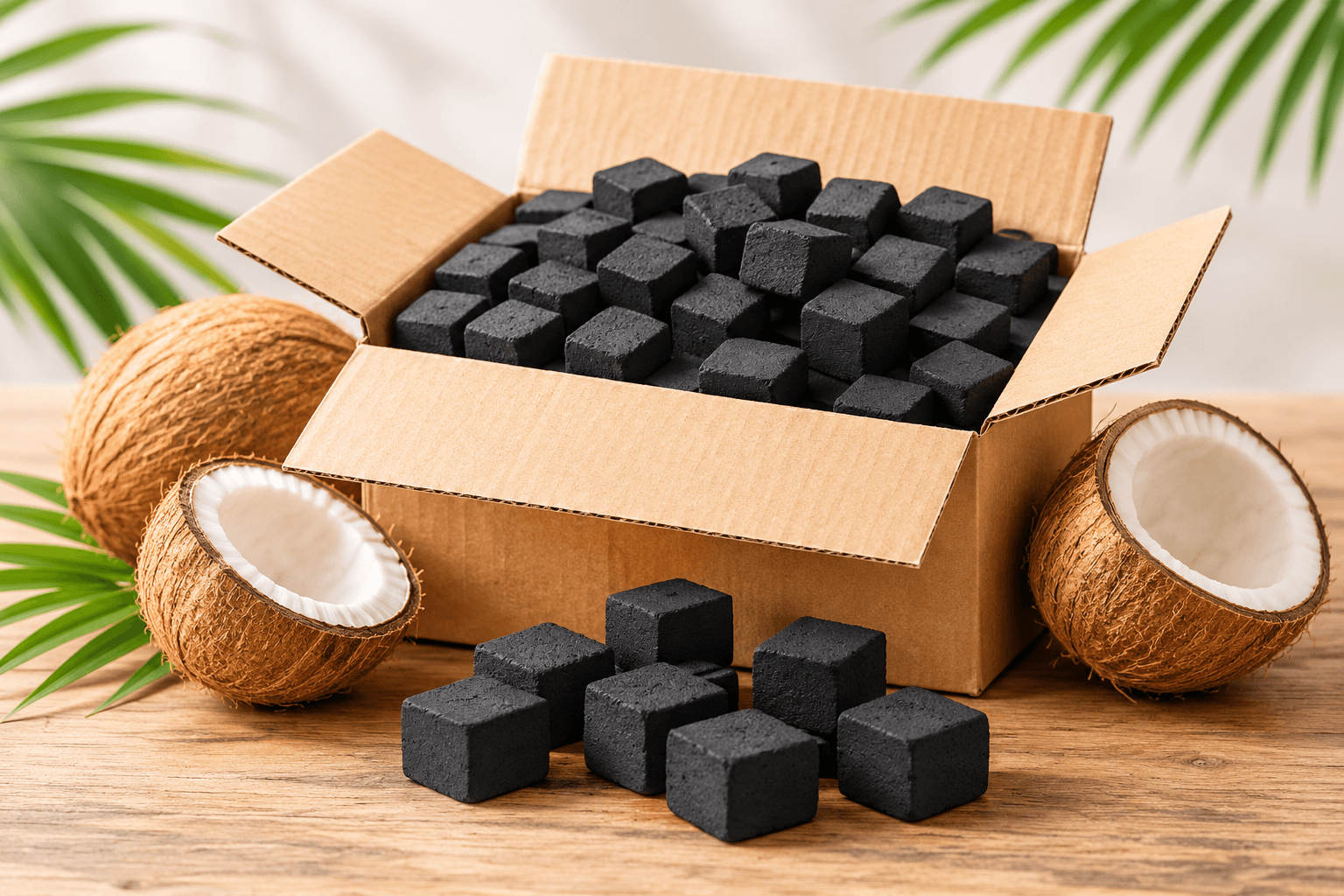
Why does charcoal burn hotter than wood?
Charcoal burns hotter than wood because it is mostly carbon. During carbonisation, moisture and most volatile compounds are driven off, so more of the fuel's energy becomes usable heat instead of being spent evaporating water or feeding smoky flames.
What holds wood back
Wood contains significant water and volatile matter. When it burns, part of its energy goes into drying the wood and releasing gases. Those gases burn as flames that rise and fall, which makes heat output uneven and produces smoke.
How charcoal burns differently
Charcoal burns as a steady, glowing ember that gives off radiant heat. Little water or volatile material remains, so it delivers a more even burn.
What this means for buyers
Higher energy per kilogram, because less mass is water or volatiles
More consistent heat, useful for grilling and shisha sessions
Less smoke, which matters for indoor lounges, restaurants and food quality
What happens during the production of charcoal?
Charcoal is made through carbonisation. The raw material is heated with limited oxygen, which drives off water and volatile compounds and leaves a carbon-rich solid.
From coconut shell to briquette
For coconut charcoal briquettes, the raw material is coconut shell charcoal. It is shaped into uniform forms such as cubes or hexagonal briquettes, depending on the end use.
Why the process matters
How well the material is carbonised and processed affects its fixed carbon, moisture and volatile matter levels. These values determine heat output, smoke and burn time. They are why buyers should compare specification sheets rather than rely on general product descriptions.
Which specifications show how hot and how long charcoal will burn?
Five specifications predict charcoal performance: fixed carbon, calorific value, moisture, volatile matter and ash.
Fixed carbon: the main heat-producing fraction
Calorific value (kcal/kg): energy content per kilogram
Moisture content: lower moisture means faster ignition and less wasted energy
Volatile matter: affects smoke and flame behaviour
Ash content: residue left after burning, which matters for clean shisha bowls and grills
Specification glossary
Specification | What it tells the buyer |
|---|---|
Fixed carbon (%) | How much of the fuel produces steady, glowing heat |
Calorific value (kcal/kg) | Total energy available per kilogram |
Moisture (%) | Ease of ignition and energy lost to evaporation |
Volatile matter (%) | Likelihood of smoke, flame and odour |
Ash (%) | Amount of residue to clean up after use |
How do coconut shell briquettes compare with firewood?
Coconut shell briquettes are generally drier, less smoky and more uniform than firewood. This gives them steadier heat and makes them easier to handle and store.
Factor | Firewood | Coconut charcoal briquette |
|---|---|---|
Moisture | Varies; often significant | Low; specified on the spec sheet |
Smoke | Noticeable, especially when damp | Minimal when properly carbonised |
Heat consistency | Fluctuates with flame | Steady radiant ember |
Shape uniformity | Irregular logs and pieces | Uniform cubes or hexagons |
Storage and handling | Bulky; sensitive to damp | Compact; packed in boxes |
Why uniform shapes matter
Briquettes that share the same size and shape burn in a similar way. Shisha lounges and commercial kitchens can then plan fuel use and session times with more confidence.
Coconut Shell Shisha Charcoal Cubes: specifications for hookah buyers
Our Coconut Shell Shisha Charcoal Cubes are made from 100% coconut shell charcoal, with no added chemicals. They originate from Indonesia and come in 25 mm and 26 mm cube sizes.
Key specifications
Fixed carbon: 80–85%
Ash content: max 2.5%
Moisture content: max 5%
Volatile matter: max 15%
Calorific value: 7,200–7,600 kcal/kg
Grades
Grade | Size | Burn time | Typical use |
|---|---|---|---|
Cube 25 mm | 25 × 25 × 25 mm | Approx. 2–2.5 h | Standard hookah bowls, home use, retail packs |
Cube 26 mm | 26 × 26 × 26 mm | Approx. 2.5–3 h | Longer sessions in shisha lounges and cafés |
Burning properties
Ignition takes approx. 1–5 minutes on an electric stove.
The cubes are odorless and smokeless, and they produce no sparks.
Coconut Charcoal BBQ Briquettes: specifications for grill and food-service buyers
Our Coconut Charcoal BBQ Briquettes are food-grade coconut shell charcoal, with no added chemicals. They originate from Indonesia and come in cube and hexagonal shapes.
Key specifications
Fixed carbon: 75–85%
Ash content: 6.2–15%
Moisture content: max 7%
Calorific value: 6,998–7,600 kcal/kg
Grades
Grade | Burn time | Typical use |
|---|---|---|
Cube 25 mm | Approx. 2–2.5 h | Small grills, quick cooking, retail packs |
Cube 26 mm | Approx. 2.5–3 h | Home barbecues, medium-length grilling |
Hexagonal 5 × 10 cm | Approx. 4–5 h | Restaurants, satay and street-food grills |
Hexagonal 5 × 15 cm | Approx. 5–6 h | Commercial kitchens, catering, long cooking sessions |
Burning properties
Ignition takes approx. 1–5 minutes on an electric stove.
The briquettes are odorless and smokeless, produce no sparks, and need no fan.
How to source charcoal briquettes from Indonesia
To source charcoal briquettes from Indonesia, first decide whether to buy directly from a factory or through a sourcing partner. Then define your specifications clearly before requesting quotations.
Factory or charcoal supplier: what is the difference?
Coconut shell charcoal briquettes factory: produces the briquettes. Buying direct can suit buyers who can manage supplier vetting, quality checks and export logistics themselves.
Charcoal supplier or sourcing partner: connects buyers with production and coordinates specifications, packing and shipment. This can suit buyers who want one point of contact.
Where PT Sembada Niaga Nusantara fits
PT Sembada Niaga Nusantara is a young, verification-driven trading and sourcing partner for coconut charcoal from Indonesia. We are not a factory. We aim to grow step by step toward processing and, over time, our own production.
Packing and minimum order
Packing: box with inner plastic
Minimum order (MOQ): 1 × 20 ft container
Our verification approach
We aim to confirm specifications against the grade agreed with each buyer before shipment. Please ask us about the documentation and samples available for your order, and we will confirm what we can provide.
Buyer checklist
- Target application: shisha, retail BBQ, restaurant or catering
- Size and shape: 25 mm or 26 mm cube, or 5 × 10 cm or 5 × 15 cm hexagonal
- Required specification ranges: fixed carbon, ash, moisture and calorific value
- Destination-market requirements: labelling, documentation and import rules
Which coconut charcoal briquette fits your application?
Match the briquette to how long and how cleanly you need it to burn.
Application | Recommended product |
|---|---|
Shisha and hookah | Shisha cubes, 25 mm or 26 mm |
Retail BBQ packs | BBQ cubes, 25 mm |
Home grilling | BBQ cubes, 26 mm |
Restaurants and street food | Hexagonal 5 × 10 cm |
Catering and long sessions | Hexagonal 5 × 15 cm |
To request a quotation, send us your application, preferred grade and destination port.
Request a quote, specification sheet or samples
If you are evaluating coconut charcoal from Indonesia, contact PT Sembada Niaga Nusantara with your requirements. You can request a quotation or a specification sheet, or ask about samples for the grade you need. We will review your application and target specifications, then respond with the details we can confirm.